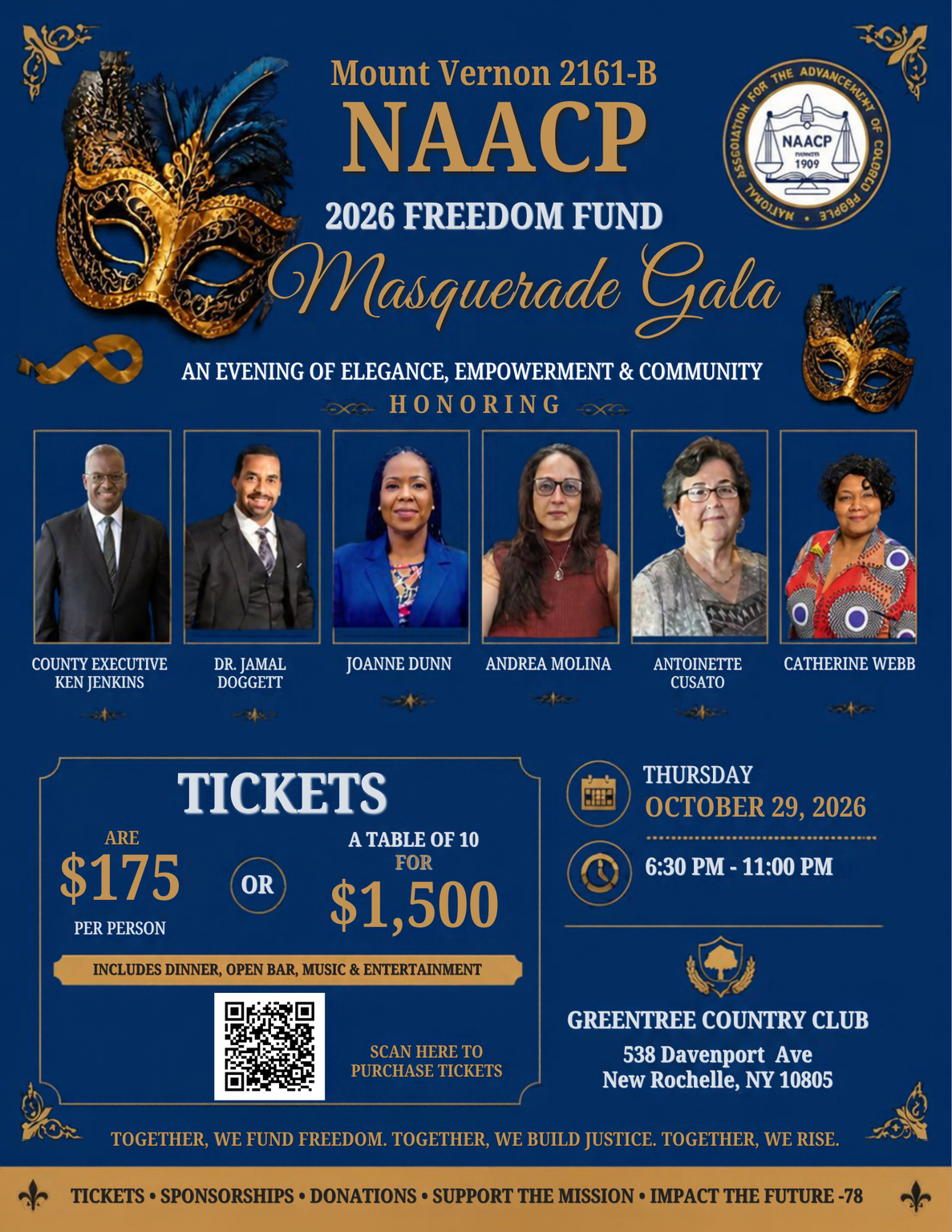
Everybody loves to talk about “supporting Black businesses.”
Everybody loves to say “health is wealth.”
Everybody loves to post a flyer during Black History Month.
But support...
Westchester County Executive Ken Jenkins provides an update on current weather conditions, Monday afternoon .
Westchester County is extending the complete road ban until 6 pm...
Democratic nominee Shawyn Patterson-Howard (SPH) made history Tuesday, November 5, 2019, when she narrowly won the general election, becoming the First Female Mayor elected in...
A line from the political drama House of Cards captures a truth that applies far beyond politics. The character Frank Underwood once said:
“Money is the McMansion in Sarasota that starts falling apart after 10 years. Power is the old stone building that has stood for centuries.”
That quote perfectly explains the debate surrounding the recent distribution changes involving The Breakfast Club, including its move into a deal with Netflix through its parent distribution network.
At first glance, deals like this appear attractive. Large platforms offer guaranteed revenue, global distribution, and the prestige of being connected to one of the world's largest streaming services. For any show, especially one that has been on the air for years, securing a large contract can look like the logical next step.
But media history shows that the biggest check is not always the best long-term strategy.
The real issue is not just money but the lasting power of...
The recent buyout of Tyler Perry’s ownership stake in BET+ marks more than a corporate restructuring. It signals the end of the last remaining piece of Black ownership connected to the BET ecosystem.
With Paramount Global purchasing Perry’s stake, the streaming service is now fully controlled by the same corporation that already owns Black Entertainment Television. BET+ is expected to be folded into Paramount+ as part of the company’s broader strategy to consolidate its streaming platforms.
For many viewers, this may look like a routine business decision. Large media companies restructure assets all the time. But the symbolism of this particular transaction is difficult to ignore.
Tyler Perry’s investment in BET+ represented the final direct ownership link between Black capital and the BET brand. While BET itself had long been part of a corporate media structure, Perry’s stake in the streaming platform meant that a major Black creator still held equity in a piece of the distribution system tied to the network.
That is no longer the case.
With the buyout complete, the entire BET ecosystem now sits fully inside Paramount Global’s corporate portfolio. What once stood as a Black-owned media institution has become another brand within a multinational entertainment conglomerate.
This distinction matters because ownership and representation are not the same thing.
Black culture remains one of the most powerful forces in global entertainment. Black actors, writers, directors, musicians, and producers continue to shape popular culture at every level.
But influence does not equal ownership.
Ownership determines who controls the platform.
Ownership determines who captures the long-term economic value created by media.
Ownership determines who ultimately decides what content is produced and how it reaches audiences.
This does not mean Black creators will disappear from television or streaming platforms. Black culture will continue to drive audiences, shape trends, and influence global entertainment.
The real question is not whether Black content will exist. The real question is what kind of Black content will be produced — and who will decide what stories are told.
Who will control how our history is portrayed?Who will shape the narratives about our communities?And what will our children be taught about our culture through the media they consume?
Major studios and networks understand the economic value of Black cultural influence. But when ownership of the platforms sits entirely outside the community, the power to define the message no longer belongs to the culture that created it.
For decades, BET symbolized something larger than entertainment. It represented the possibility that Black entrepreneurs could build and control a national media platform. Even after the network itself became part of a corporate structure, Tyler Perry’s stake in BET+ maintained at least some connection between Black ownership and the distribution of Black-focused content.
That connection is now gone.
Major Media Platforms Owned by Paramount
Paramount Global owns one of the largest entertainment portfolios in the world. Its holdings include broadcast networks, cable channels, streaming services, movie studios, and global distribution arms.
Broadcast Networks
CBS
CBS News
CBS Sports
CBS Television Stations
Streaming Platforms
Paramount+
Pluto TV
CBS News 24/7
CBS Sports HQ
Cable Networks
Paramount Media Networks controls a large group of cable brands including:
BET
BET Her
MTV
VH1
Nickelodeon
Nick Jr.
Comedy Central
Paramount Network
TV Land
Logo
CMT
Pop TV
Smithsonian Channel
Showtime
The Movie Channel
Flix
Film and Studio Businesses
Paramount Pictures
Paramount Animation
Paramount Players
Paramount Television Studios
Nickelodeon Movies
Republic Pictures
49% stake in Miramax
Production and Distribution
CBS Studios
Showtime/MTV Entertainment Studios
Nickelodeon Animation Studio
Paramount Global Content Distribution
International Networks
Paramount also operates international versions of many channels across Europe, Africa, Latin America, and Asia
The buyout of Tyler Perry’s stake in BET+ therefore represents more than the end of a business partnership. It highlights a broader reality about the modern media landscape: Black culture remains highly visible, but Black ownership of major national media platforms has become increasingly rare.
The BET brand will continue. The programming will continue. The audience will certainly continue.
But with this transaction, the last piece of Black ownership connected to the BET ecosystem has now disappeared.
And that reality raises an important question for the future of Black media: if the platforms that distribute Black culture are no longer owned by Black institutions, what will it take to build new ones?
For families like mine, Puerto Rico is not a headline.
It’s a grandmother’s voice that still lives in the ear.
It’s land that remembers footsteps even...
January 6, 2026. Early evening. And surprisingly warm, especially compared to the frigid stretch January had been putting us through. Not warm enough to...
Adriana Erin Rivera, an award-winning New Jersey-raised author of Puerto Rican descent, shared excerpts of her first book published by the Smithsonian Institute, "Paloma's...
For decades, the Klingons in Star Trek represented one of the most clearly defined warrior cultures in science fiction. Honor, lineage, loyalty, and courage were not...
And Why Too Many Black Leaders Refuse to Talk About It
In politics, policies are often judged by their intentions. In economics, they are judged by their outcomes.
That distinction matters when examining the estate tax proposal being pushed by Zohran Mamdani, which would dramatically lower the estate-tax exemption in New York from roughly $7 million to about $750,000 while raising the top rate as high as 50 percent.
Supporters frame the proposal as a tax on the wealthy.
But when viewed through the lens of economic reality, the estate tax proposal could severely harm Black middle-class wealth, especially those relying on family homes as their primary asset, highlighting the urgent...
A line from the political drama House of Cards captures a truth that applies far beyond politics. The character Frank Underwood once said:
“Money is the McMansion in Sarasota that starts falling apart after 10 years. Power is the old stone building that has stood for centuries.”
That quote perfectly explains the debate surrounding the recent distribution changes involving The Breakfast Club, including...
The recent buyout of Tyler Perry’s ownership stake in BET+ marks more than a corporate restructuring. It signals the end of the last remaining piece of Black ownership connected to the BET ecosystem.
With Paramount Global purchasing Perry’s stake, the streaming service is now fully controlled by the same corporation that already owns Black Entertainment Television. BET+ is expected to be folded into Paramount+ as part of the company’s broader strategy to consolidate its streaming platforms.
For many viewers, this may look like a routine business decision. Large media companies restructure assets all the time. But the symbolism of this particular transaction is difficult to ignore.
Tyler Perry’s investment in BET+ represented the final direct ownership link between Black capital and the BET brand. While BET itself had long been part of a corporate media structure, Perry’s stake in the streaming platform meant that a major Black creator still held equity in a piece of the distribution system tied to the network.
That is no longer the case.
With the buyout complete, the entire BET ecosystem now sits fully inside Paramount Global’s corporate portfolio. What once stood as a Black-owned media institution has become another brand within a multinational entertainment conglomerate.
This distinction matters because ownership and representation are not the same thing.
Black culture remains one of the most powerful forces in global entertainment. Black actors, writers, directors, musicians, and producers continue to shape popular culture at every level.
But influence does not equal ownership.
Ownership determines who controls the platform.
Ownership determines who captures the long-term economic value created by media.
Ownership determines who ultimately decides what content is produced and how it reaches audiences.
This does not mean Black creators will disappear from television or streaming platforms. Black culture will continue to drive audiences, shape trends, and influence global entertainment.
The real question is not whether Black content will exist. The real question is what kind of Black content will be produced — and who will decide what stories are told.
Who will control how our history is portrayed?Who will shape the narratives about our communities?And what will our children be taught about our culture through the media they consume?
Major studios and networks understand the economic value of Black cultural influence. But when ownership of the platforms sits entirely outside the community, the power to define the message no longer belongs to the culture that created it.
For decades, BET symbolized something larger than entertainment. It represented the possibility that Black entrepreneurs could build and control a national media platform. Even after the network itself became part of a corporate structure, Tyler Perry’s stake in BET+ maintained at least some connection between Black ownership and the distribution of Black-focused content.
That connection is now gone.
Major Media Platforms Owned by Paramount
Paramount Global owns one of the largest entertainment portfolios in the world. Its holdings include broadcast networks, cable channels, streaming services, movie studios, and global distribution arms.
Broadcast Networks
CBS
CBS News
CBS Sports
CBS Television Stations
Streaming Platforms
Paramount+
Pluto TV
CBS News 24/7
CBS Sports HQ
Cable Networks
Paramount Media Networks controls a large group of cable brands including:
BET
BET Her
MTV
VH1
Nickelodeon
Nick Jr.
Comedy Central
Paramount Network
TV Land
Logo
CMT
Pop TV
Smithsonian Channel
Showtime
The Movie Channel
Flix
Film and Studio Businesses
Paramount...
A deadly police shooting in Dallas has raised new questions after authorities confirmed the man killed had previously worked security at events connected to U.S. Representative Jasmine Crockett.
The man, identified in reports as Mike King, was shot and killed by Dallas Police Department officers following a tense standoff earlier this week.
While police say the shooting occurred after the suspect pointed a gun at officers, the revelation that he had previously worked security connected to a member of Congress has triggered scrutiny over vetting and security practices.
What Happened
According to police, officers were attempting to arrest King on a warrant related to impersonating a law enforcement officer.
Authorities tracked him to a parking garage near Children’s Health Hospital in Dallas, where he barricaded himself inside a vehicle. A SWAT response team was called to the scene.
After negotiations failed, officers deployed tear gas to force him out of the vehicle. Police say that when King exited the car, he emerged holding a firearm and pointed it toward officers.
Officers opened fire.King was pronounced dead at the scene.
No officers were injured during the incident.
A Security Contractor With Political Connections
Investigators later confirmed that King had previously provided security services at events involving Rep. Jasmine Crockett, a first-term Democratic congresswoman representing parts of Dallas and surrounding areas.
Reports indicate King operated a company that connected off-duty police officers with private security jobs, including political events.
Campaign finance records and public documentation reportedly show payments for security services linked to Crockett’s events within the past year.
There is currently no indication that Crockett or her office were aware of any criminal investigation involving King prior to the incident.
Her office has not issued a formal statement about the situation as of this writing.
Allegations of Police Impersonation
The warrant that led police to King was connected to allegations that he had been impersonating a law enforcement officer.
Investigators say he was suspected of using:
A replica undercover police-style vehicle
Stolen or altered license plates
Multiple aliases
Authorities are still investigating the full scope of those allegations.
Questions About Security Vetting
The incident has raised broader questions about how private security contractors are vetted for political events, particularly for elected officials who frequently rely on private firms rather than government protective services.
Members of Congress typically do not receive full-time federal protection unless they hold leadership roles or face specific threats. As a result, many campaigns and offices hire private security contractors for events.
The Dallas shooting has now sparked debate over whether additional background checks or licensing requirementsshould be implemented for individuals providing security for elected officials.
The Larger Debate
For critics, the situation highlights what they see as a growing problem with the loosely regulated private security industry.
Others argue the focus should remain on the circumstances of the police encounter itself, noting that officers say the shooting occurred only after the suspect pointed a weapon at law enforcement during an active standoff.
The investigation into the incident is ongoing.
What is clear is that the case now sits at the intersection of law enforcement, political security, and public accountability—a combination that almost guarantees continued scrutiny in the days ahead.